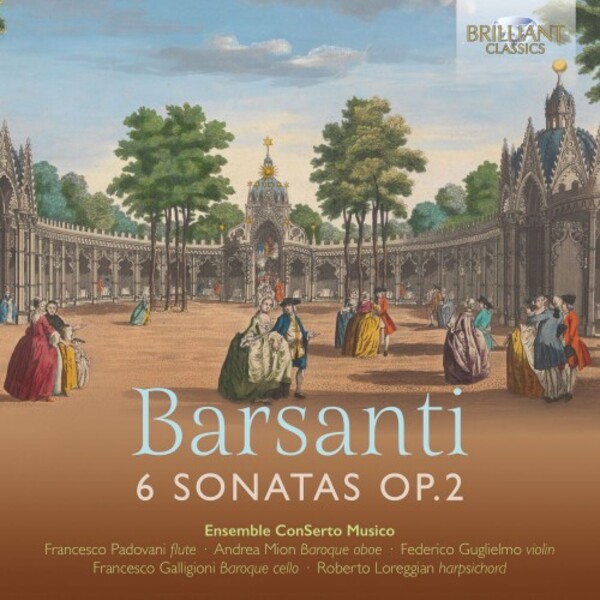
Barsanti - 6 Sonatas, op.2
£9.45
In stock - available for despatch within 1 working day
Despatch Information
This despatch estimate is based on information from both our own stock and the UK supplier's stock.
If ordering multiple items, we will aim to send everything together so the longest despatch estimate will apply to the complete order.
If you would rather receive certain items more quickly, please place them on a separate order.
If any unexpected delays occur, we will keep you informed of progress via email and not allow other items on the order to be held up.
If you would prefer to receive everything together regardless of any delay, please let us know via email.
Pre-orders will be despatched as close as possible to the release date.
Label: Brilliant Classics
Cat No: 96243
Format: CD
Number of Discs: 1
Genre: Chamber
Release Date: 13th June 2025
Contents
Works
A Collection of Old Scots TunesArtists
Ensemble ConSerto MusicoWorks
A Collection of Old Scots TunesArtists
Ensemble ConSerto MusicoAbout
The Sonatas featured here were first published in 1728, with a title page suggesting their suitability for flute, though a later edition allowed for an oboe instead. The seven musicians of Ensemble ConSerto Musico have taken their cue from this flexibility and presented the sonatas with the top line played alternately by a violin, a flute and an oboe. Interleaved between the sonatas are arrangements made by Barsanti of Scots folktunes such as ‘O Dear Mother, What Shall I Do’ and ‘Corn Riggs Are Bonny’.
Thus the album presents an attractive varied musical sequence as well as a handsome illustration of Barsanti’s diverse talents. Born in the Puglian town of Lucca, he arrived in the English capital at some point in the early 1720s, and rapidly made himself useful as a jobbing musician, copyist and composer, without ever attaining the celebrity of a Handel or even a Geminiani. Hence his relative obscurity in our own age.
However, the sonatas demonstrate more than a fluent contrapuntal technique. The melodic lines are always gracefully turned, whether slow or quick, and while they have been carefully made not to demand virtuoso performance, Barsanti’s art conceals considerable sophistication in form and construction which makes the sonatas as pleasing to play as to listen to.
His profile was perhaps lower among his professional colleagues, but this seems to have been due more to his own unassertiveness than to any lack of respect.
The sonatas, as well as the rest of his considerable surviving output, pursue a goal of combining learned technique (in form and polyphony) with fashionable trends in taste which would sell his music and carry it to new audiences, and beyond Handel and Geminiani, no composer in 18th-century England fulfilled that aim beyond Barsanti himself.
Error on this page? Let us know here
Need more information on this product? Click here